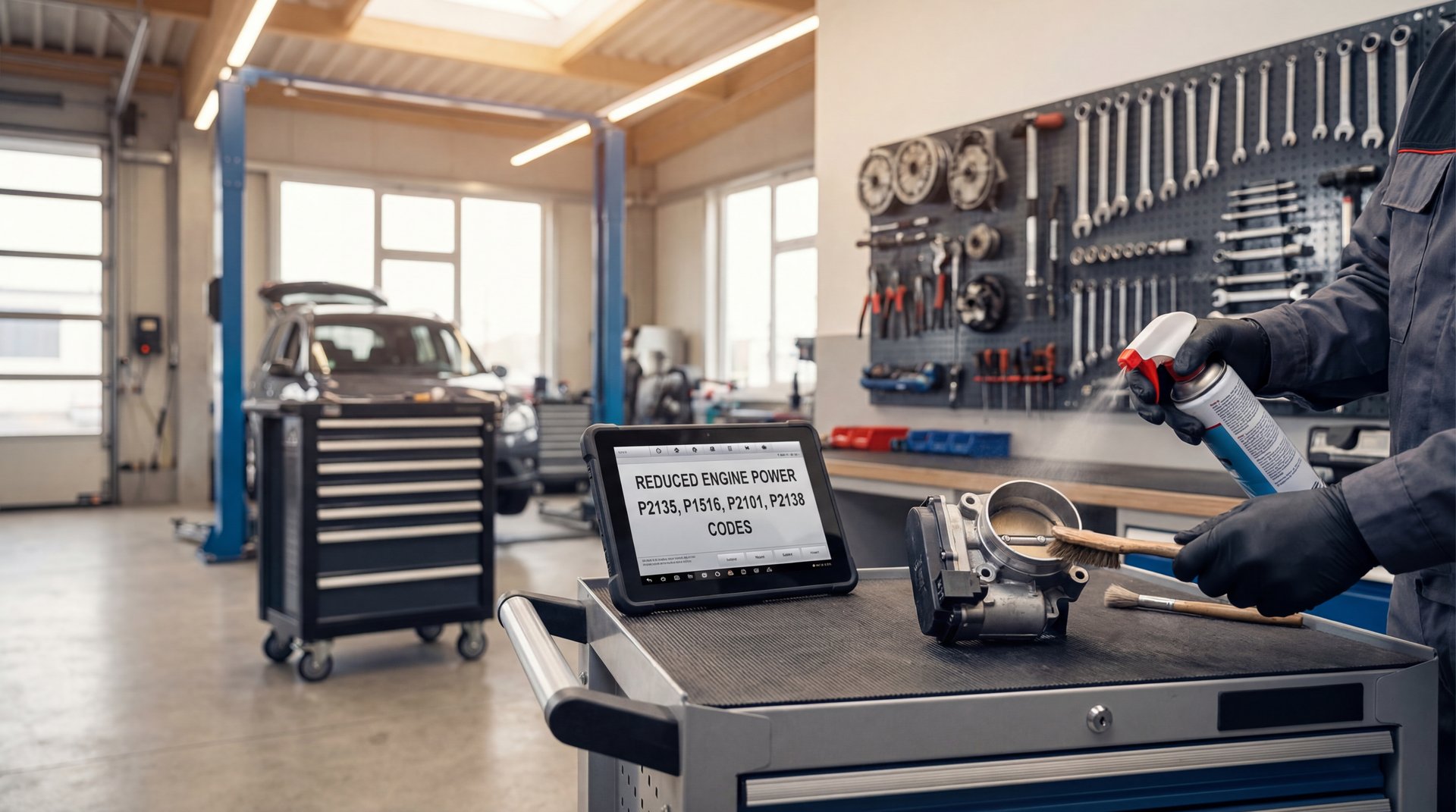
Alright guys, so here’s the deal. Your check engine light just popped on and you’re seeing that dreaded “Reduced Engine Power” message on your dash. Your car basically goes into limp mode and won’t let you accelerate past 20-25 miles per hour. Trust me, I know how frustrating this is, and I get customers coming in with this issue all the time. The good news? In most cases, you can fix this yourself without dropping hundreds of dollars on parts. Today we’re going to talk about what causes codes like P2135, P1516, P2101, and P2138, and more importantly, what you can actually do about it before you start throwing parts at the problem.
What Causes the Reduced Engine Power Message
So when that reduced engine power message pops up on your dash, what’s actually happening? Basically, your car’s computer is detecting a problem with the electronic throttle control system. The most common codes you’ll see are P2138, P2135, P1516, and P2101. These codes all point to issues with your accelerator pedal position sensor or your throttle body.
Let me break this down real quick. You’ve got your accelerator pedal position sensor, which is basically monitoring how far you’re pushing down the gas pedal. Then you’ve got your throttle body under the hood, which has these throttle plates inside that open and close to control airflow into your engine. These two components need to work together perfectly, and when there’s a correlation issue between what your foot is doing and what the throttle body is doing, that’s when you get thrown into reduced engine power mode.
🔧 Pro Tip
The P2138 code specifically means there’s a correlation issue between the accelerator pedal position sensor and the electronic throttle body. Don’t panic and start buying parts just yet – we’re going to show you the cheap fixes first.
Here’s the thing – a lot of times it’s not actually a bad sensor or a bad throttle body. What happens is those throttle plates inside the throttle body get dirty over time. Carbon buildup, oil residue, all that stuff accumulates in there. If those plates get stuck or jammed even slightly, your car’s computer sees that as a major problem and immediately puts you in limp mode as a safety precaution.
How to Get Out of Limp Mode Fast
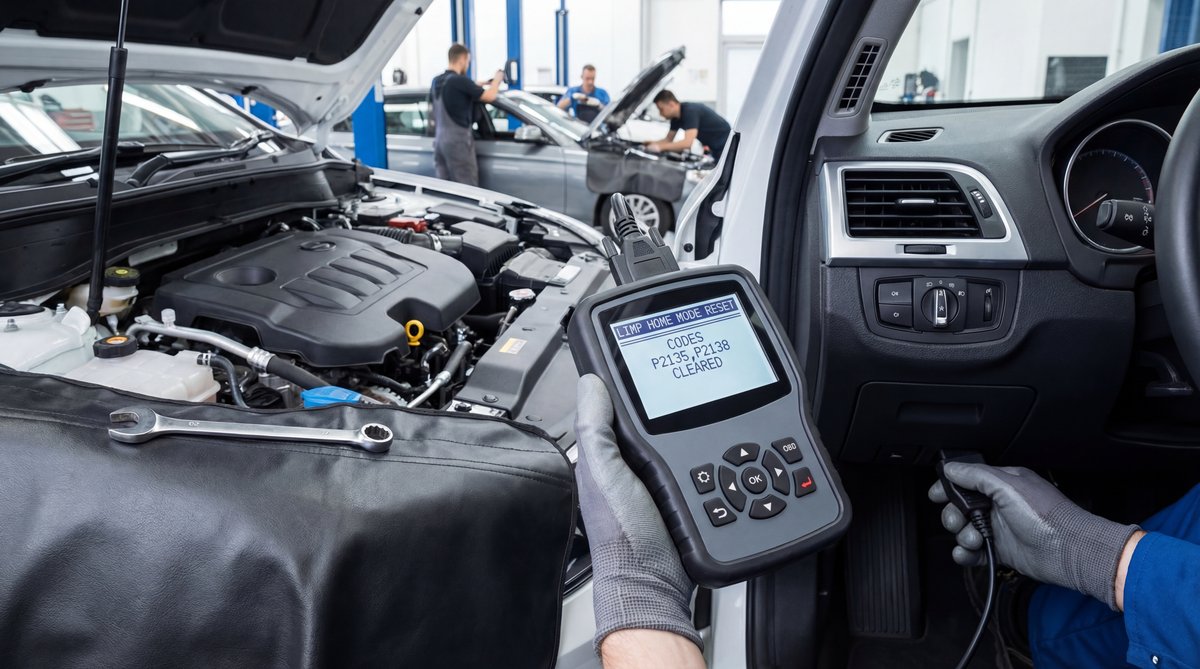
Alright, so you’re driving along and suddenly that message pops up and your car won’t accelerate. First thing you need to do is stay calm and get somewhere safe. Here’s the simple trick that works probably 90% of the time to get you back on the road.
Pull over somewhere safe, shut your vehicle completely off, and take your key out of the ignition. Let it sit for about 30 seconds. This gives your car’s computer time to reset. Put your key back in, start it up, and chances are you’re going to be off and running again. You’ll be able to drive perfectly fine, at least temporarily.
⚠️ Warning
This reset trick will usually get you driving again, but it’s NOT a permanent fix. The light will likely come back if you don’t address the root cause. Use this to get yourself home or to a safe place where you can properly diagnose the problem.
Now, unless you have a hard electrical failure – meaning something is actually broken – this reset should get you going again. But here’s what you need to understand: the problem isn’t gone, it’s just temporarily cleared. You need to actually fix what’s causing it, otherwise that message is going to keep popping back up.
Locating Your Accelerator Pedal Position Sensor and Throttle Body
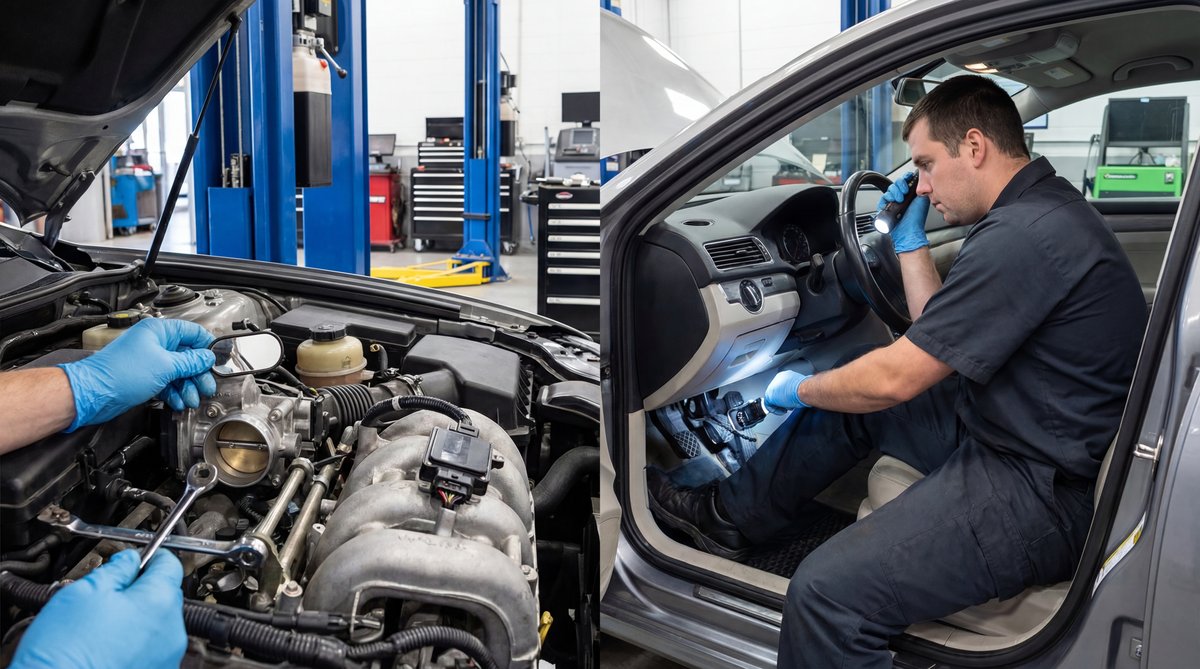
Let me show you where these components actually are so you know what we’re dealing with. Your accelerator pedal position sensor is located right up at the top of your accelerator pedal assembly. It’s not just the sensor itself – when you buy a replacement, it comes as the whole pedal assembly with the sensor built into the top portion.
The sensor itself monitors the position of your pedal and sends that information to your car’s computer. Depending on your vehicle, you’re looking at anywhere from $50 to $150 for an aftermarket accelerator pedal position sensor, and up to $200 or more for OEM parts from the dealer. That’s why you want to make sure you actually need to replace it before you start spending money.
🔧 Tools Needed for This Job
- Throttle body cleaner or carb cleaner
- Old toothbrush (for scrubbing)
- Basic ratchet set (metric)
- OBD-II scanner (to read and clear codes)
- Flathead screwdriver (for clamps)
- Shop rags or paper towels
Now let’s talk about the throttle body. This is located under your hood, usually right after your air filter housing. You’ll see a large intake boot that connects to it. Inside the throttle body, you’ve got these throttle plates that physically open and close. When you step on the gas, those plates open to let more air in. When you let off, they close. Pretty simple concept, but when they get gunked up, that’s when problems start.
The throttle body itself, if you do need to replace it, can run you anywhere from $150 on the low end for aftermarket to $450 or more for OEM, depending on your vehicle. Again, these components can be pricey, so if you can avoid replacing them by just cleaning that throttle body, you definitely want to start there.
| DIY Cost | Shop Cost | You Save |
|---|---|---|
| $8-15 (cleaner only) | $200-400 | $185-385 |
Cleaning Your Throttle Body to Fix the Problem
Alright, so here’s what we’re gonna do to actually fix this thing. You need to clean out that throttle body. I’ve got one here that I already took off so you can see what we’re dealing with. See these throttle plates? They open and close, and if they get jammed or stuck in any way, that’s what throws your car into reduced engine power mode.
The beauty of this fix is that a lot of times you don’t even need to remove the throttle body from the vehicle. You can do this right there under the hood. What you want to do is disconnect that air intake boot that connects to the throttle body. On most vehicles, there’s just a clamp or two holding it on – loosen those up and pull the boot off so you can access the inside of the throttle body.
🔧 Pro Tip
Before you start spraying cleaner everywhere, it’s a good idea to disconnect your battery. This automatically forces the computer to do an idle relearn when you reconnect it, which can help with any rough idle issues after cleaning.
Grab yourself a can of throttle body cleaner or brake cleaner – either one works fine. You’re also going to want an old toothbrush. Spray that cleaner inside the throttle body and scrub the throttle plates really good with the toothbrush. You’ll probably see a bunch of black carbon buildup in there. That’s what we’re trying to get rid of.
Hold those throttle plates open while you’re cleaning so you can get both sides of them and all around the edges where they seal against the throttle body housing. Get in there and scrub it out real good. Use plenty of cleaner and keep scrubbing until you see clean metal and all that carbon buildup is gone.
❌ Common Mistake
Don’t force the throttle plate open too hard or you might damage the electronic motor inside. Just gently hold it open while you clean. And don’t spray cleaner directly onto any electrical connectors – keep it on the metal parts only.
Once you’ve got it all cleaned up, let everything dry for a few minutes. Then reconnect everything – put your air intake boot back on, tighten up those clamps, and reconnect your battery if you disconnected it. Start the car up and let it idle for a minute. The computer might need to relearn the idle position, so it might run a little funny for the first minute or two, but that’s normal.
Now here’s the deal – if this is all your problem was, just a dirty throttle body, you just fixed your reduced engine power issue for the cost of a $10 can of cleaner and an hour of your time. No parts, no money spent at a shop, just a little preventative maintenance. That’s a pretty good deal if you ask me.
When You Actually Need to Replace Parts
Alright, so what if you cleaned the throttle body and the problem keeps coming back? Then obviously you’re going to have to do a little further diagnostic work. At that point, you’re looking at potentially replacing either the throttle body itself or the accelerator pedal position sensor.
If the throttle body is cleaned out and those plates are moving freely but you’re still getting the codes, chances are you’ve got an issue with the sensors or the electronic motor inside the throttle body. I actually have another video where we take apart a throttle body and show you the internal components and what causes them to fail. You’ll want to check that out for more detailed diagnostic information.
If you can avoid replacing these components by just cleaning that throttle body, you definitely want to start there. These parts can be pricey, and cleaning solves the problem most of the time.
The other possibility is your accelerator pedal position sensor. To properly diagnose this, you’d want to use a multimeter to test the voltage coming from the sensor as you press the pedal. It should give you a smooth, linear increase in voltage from about 0.5 volts at rest to around 4.5 volts at full throttle. If you’re seeing erratic readings or the voltage doesn’t change smoothly, that sensor needs to be replaced.
You also want to check the wiring harness and connectors at both the throttle body and the pedal sensor. Look for any corrosion, damaged wires, or loose connections. Sometimes it’s as simple as cleaning out a corroded connector, and that’ll solve your problem right there.
💰 Money Saver
Before you buy a new accelerator pedal sensor or throttle body, check your vehicle’s warranty status. Some manufacturers have extended warranties or technical service bulletins (TSBs) for these exact issues. You might be covered and not even know it.
Here’s the thing – if you do need to replace parts, make sure you’re getting quality components. For the accelerator pedal sensor, stick with OEM or high-quality aftermarket brands like ACDelco, Denso, or Bosch. Same goes for the throttle body. Yeah, you might find cheaper knock-off parts online, but they often don’t last and you’ll be doing this job all over again in six months.
When you’re installing a new throttle body, make sure you use the proper torque specs on those mounting bolts – usually around 8-12 Newton meters or about 71-106 inch-pounds. Don’t just crank them down as tight as you can or you’ll warp the housing. And always use a new gasket if your throttle body came with one.
Similar to the variable valve timing issues we’ve covered before, these electronic throttle control problems can seem scary at first, but they’re usually pretty straightforward once you understand what you’re dealing with. Just like those VVT codes, you want to start with the simple, cheap fixes before you start replacing expensive components.
Frequently Asked Questions
What are the most common causes of the reduced engine power light?
How can I reset the reduced engine power mode on my car?
What tools are essential for diagnosing the reduced engine power issue?
Are there any specific brands of parts that are recommended for this repair?
How do I know if the throttle body is dirty or jammed?