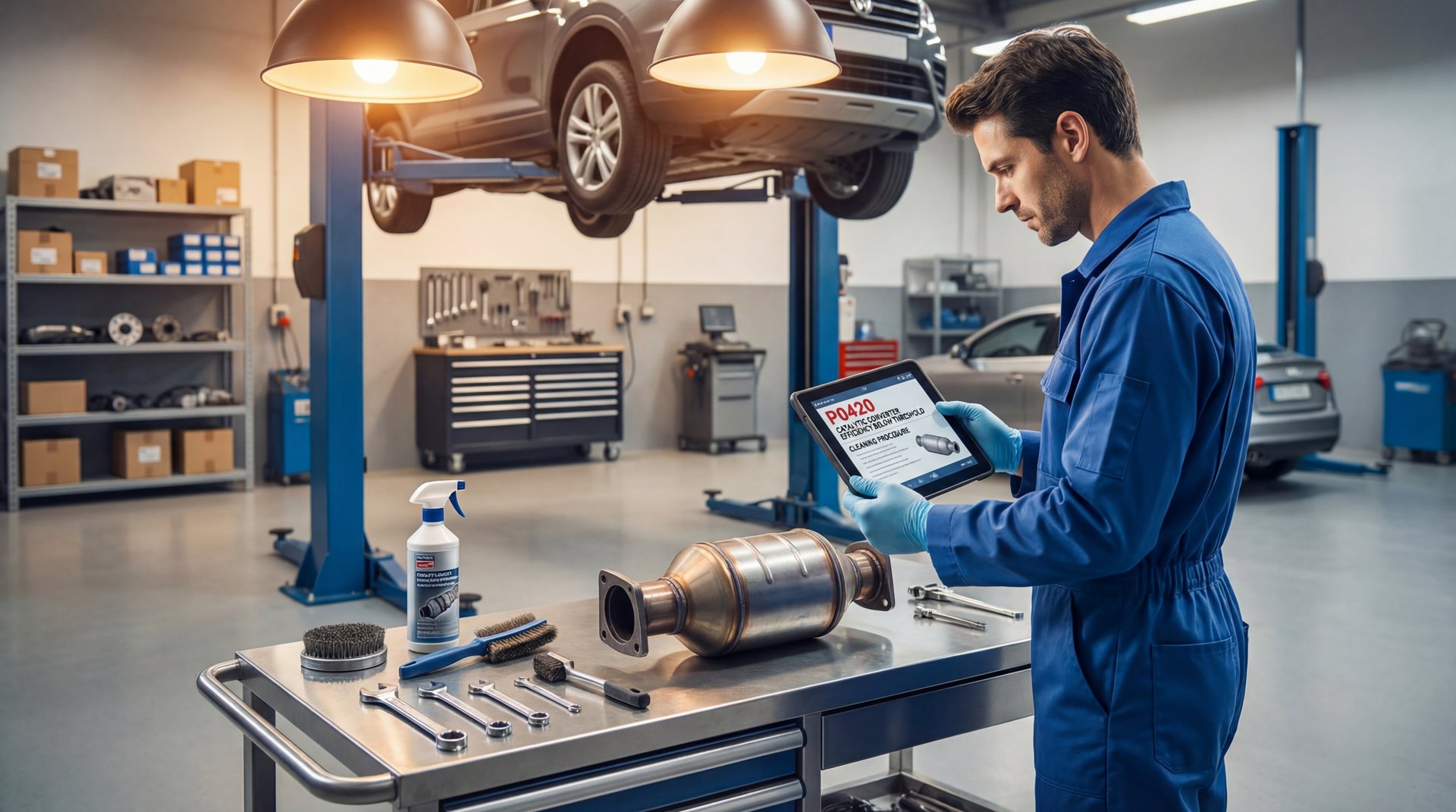
Alright guys, so you’ve got that dreaded P0420 code lighting up your dashboard. Before you panic and start looking at expensive catalytic converter replacements, I’m gonna show you a trick that might just save you hundreds of bucks. The thing is, a lot of times your cat isn’t actually dead – it’s just clogged up and needs a good cleaning. I’m gonna walk you through how to do this the right way.
Understanding the P0420 Code
So what’s actually going on when you get a P0420 code? Basically, your car’s computer is telling you that the catalytic converter efficiency is below threshold on Bank 1. What that means in plain English is your cat isn’t cleaning up the exhaust gases as well as it should be.
Now here’s the thing – a lot of people immediately think they need a brand new catalytic converter. But that’s not always the case. Your converter might just be clogged up with carbon deposits and other crud that’s built up over time.
Before you drop that kind of money, you wanna rule out some other common causes. Could be your oxygen sensors going bad, could be an exhaust leak somewhere, or maybe your engine’s running too rich and dumping extra fuel into the exhaust. But if you’ve checked all that stuff and everything looks good, then yeah, we’re looking at the converter itself.
🔧 Pro Tip
If you’re also dealing with other code issues, it’s worth checking out related problems. Similar to how we tackled the P0008 code on a Chevy Traverse, you want to make sure you’re not chasing symptoms instead of the root cause.
Removing Your Catalytic Converter
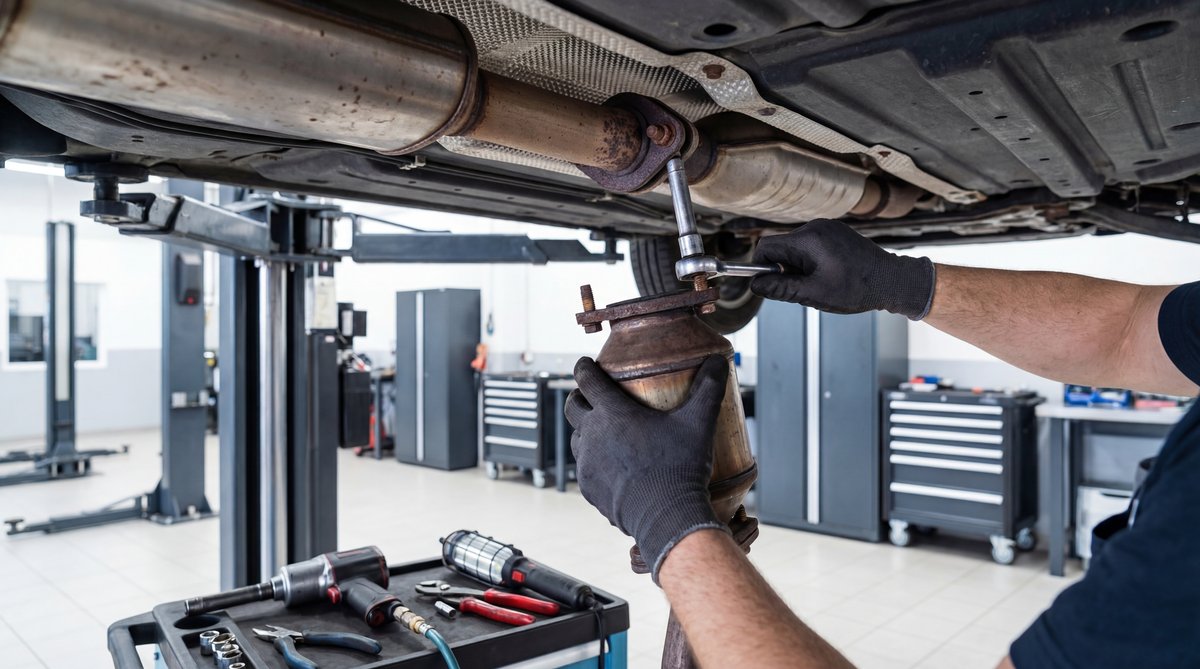
Alright, so here’s the only downfall to this whole process – you gotta take your converter off. I know that sounds intimidating, but it’s really not that bad once you get under there and see what you’re working with.
🔧 Tools You’ll Need
- Jack and jack stands (safety first, guys)
- Socket set with extensions
- Penetrating oil (trust me on this one)
- Wire brush
- Catalytic converter cleaner solution
- New gaskets (if your converter uses them)
- Torque wrench
First thing you’re gonna do is get that car up in the air safely. I can’t stress this enough – use proper jack stands. Don’t ever work under a car that’s only on a jack. Once you’re under there, locate your catalytic converter. It’s gonna be in your exhaust system, usually pretty close to the engine.
⚠️ Warning
Make sure your exhaust system is completely cool before you start working on it. I mean cold, not just “hasn’t been running for 20 minutes” cool. That thing will burn you bad if you’re not careful.
Now, the bolts holding your converter on are probably gonna be rusty and corroded. Spray them down good with penetrating oil and let it soak for at least 15-20 minutes. This is gonna save you a lot of headaches. When you start loosening those bolts, work slowly. If you feel one starting to strip or round off, stop and hit it with more penetrating oil.
❌ Common Mistake
People try to muscle through those rusty exhaust bolts and end up snapping them off. Then you’re in a world of hurt trying to drill out broken bolts. Take your time, use heat if you need to, and don’t force it.
The Cleaning Process That Actually Works
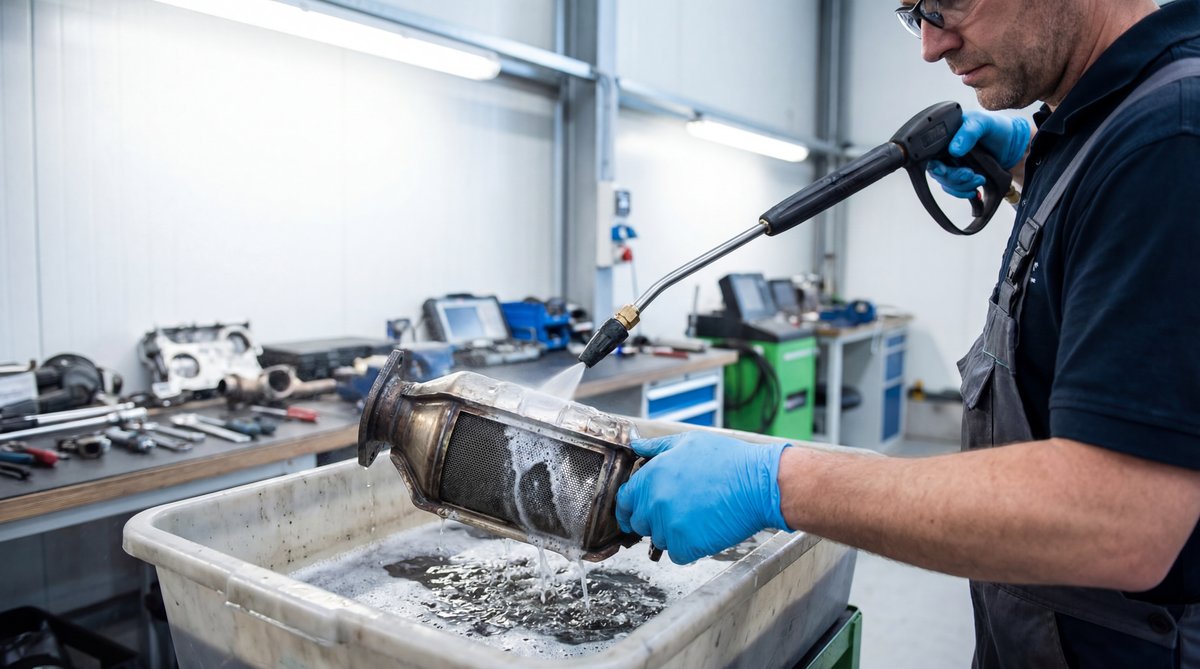
Okay, so you’ve got your converter off. Now here’s where the magic happens. You’re gonna need a good catalytic converter cleaning solution – don’t cheap out on this stuff. The good products actually work.
What you’re gonna do is basically dump some of this cleaner right into the converter. I like to plug one end, fill it up with the solution, and let it sit for a while. The instructions on your specific cleaner will tell you how long, but usually we’re talking at least a few hours. Some guys let it soak overnight.
Dump some of this in there, put it back on your car, run it through, and you’ll be good to go.
The cleaner is gonna break down all that carbon buildup and other deposits that are clogging up the honeycomb structure inside your cat. That’s what’s keeping it from doing its job properly. After it’s soaked long enough, drain out the solution and give it a good shake to get as much of the loose stuff out as you can.
💰 Money Saver
A good bottle of catalytic converter cleaner runs you about $20-$40. Compare that to a new converter at $800-$2,500, and you’re looking at serious savings. Even if you gotta try this twice, you’re still way ahead.
Some people like to rinse it out with water after the cleaner, and that’s fine. Just make sure you let it dry completely before you put it back on. You can use compressed air to blow it out, or just let it sit in the sun for a day.
| DIY Cleaning Cost | Shop Replacement Cost | You Save |
|---|---|---|
| $20-$60 | $800-$2,500 | $750-$2,400+ |
Reinstalling and Testing Your Results
Alright, so your converter is clean and dry. Now we’re gonna put everything back together. If your converter uses gaskets, this is the time to put in new ones. Don’t reuse old gaskets – they’re cheap and it’s not worth the risk of an exhaust leak.
When you’re bolting everything back up, you wanna start all the bolts by hand first. Get them all threaded in before you start tightening anything down. Then tighten them in a crisscross pattern – you know, like you’re doing lug nuts on a wheel. This keeps everything seated evenly.
🔧 Pro Tip
Don’t go crazy torquing down exhaust bolts. You want them tight, but if you overtighten them you’re just gonna break them next time you need to take them off. Check your service manual for the proper torque specs.
Once everything’s back together, start up your car and listen for any exhaust leaks. You’ll hear them if they’re there – it’ll sound louder than normal, kind of a ticking or hissing sound. If you hear anything like that, you need to track it down and fix it before you go any further.
Now here’s the important part – you need to actually drive the car and let the computer do its tests. The thing is, your check engine light isn’t gonna magically turn off right away. You can clear the code with a scanner, but the computer needs to run through what’s called a “drive cycle” to verify that the problem is actually fixed.
What I usually tell people is clear the code, then drive the car normally for about 50-100 miles. Mix it up – some highway driving, some city driving. The computer needs to see the converter working under different conditions. If that code doesn’t come back, you’re golden.
When You Actually Need a Replacement
Look, I’m gonna be straight with you – this cleaning method doesn’t work every single time. Sometimes your catalytic converter is just done, and no amount of cleaning is gonna bring it back.
If you clean your converter and that P0420 code comes right back after you’ve driven it through a full drive cycle, then yeah, you’re probably looking at a replacement. Same thing if your converter is physically damaged – if it’s got holes in it, if it’s been bashed in from road debris, or if it’s rattling because the internals have broken apart, cleaning isn’t gonna fix that.
🔧 Pro Tip
Before you buy a new converter, make absolutely sure your oxygen sensors are good. A bad O2 sensor can throw a P0420 code and make you think your cat is bad when it’s actually fine. Test those sensors first – they’re way cheaper to replace than a converter.
Another thing to consider is if your engine is burning oil or coolant. If you’ve got blue smoke coming out your tailpipe or you’re constantly adding coolant, that stuff is going right through your catalytic converter and destroying it. You gotta fix those problems first, or you’re just gonna kill your new converter too.
When you are shopping for a replacement, you’ve got choices. You can go with an OEM converter from the dealership – expensive but guaranteed to fit and work right. Or you can go aftermarket – usually cheaper, but make sure it’s actually rated for your specific vehicle. And whatever you do, stay away from those super cheap universal converters. They’re junk and they won’t last.
Frequently Asked Questions
What are the most common causes of the P0420 code?
How can I test if my catalytic converter is actually faulty?
Are there any DIY methods to clean a catalytic converter without removing it?
What tools are essential for replacing a catalytic converter?
How do I know if my oxygen sensors are causing the P0420 code instead of the catalytic converter?