# Hyundai Elantra Engine Stalling: No Check Engine Light? Discover the Surprising Culprit!
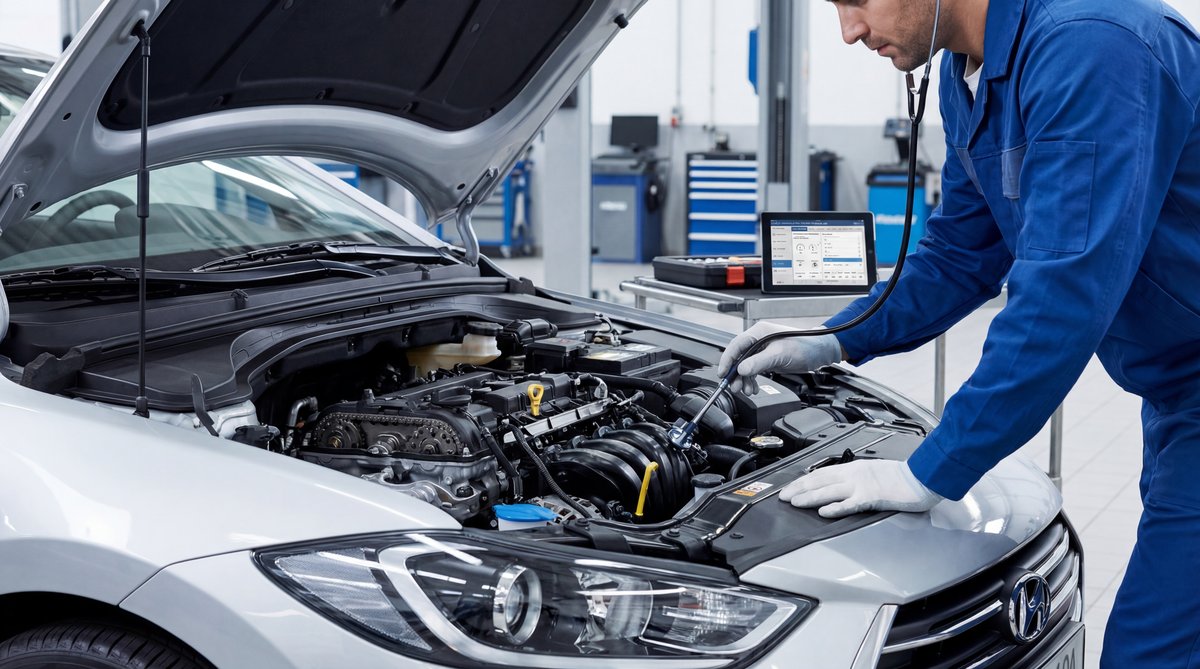
Hey, Flat Rate Mechanic here again. So we’ve got a red Hyundai Elantra in the shop today that’s been giving its owner some serious headaches. The thing keeps stalling out randomly, and here’s the kicker – no check engine light. The driver has to throw it back in park and restart it every time it dies. Now, I can tell you right off the bat from experience, these Hyundai motors are garbage. They blow up constantly. And the reason why they probably blow up is because people run them out of oil, because for some reason they love to burn oil in between oil changes. Let me walk you through what I found on this one, because what happened during my test drive was pretty eye-opening.
Initial Inspection and Test Drive
Alright guys, so this Hyundai Elantra rolls into the shop and it’s an Uber car – which tells me right away it’s probably got some serious miles on it. Let’s get it started up and see what kind of lights we’ve got on the dash.
First thing I notice: oil change light is on, and this thing’s got 151,000 miles on it. That’s a lot of miles, and that oil change reminder? Yeah, that’s probably been on for a while. Now here’s the thing – what I’ve also found on these Hyundai motors is if they’re low on oil, they will actually stall out. So we’re going to go ahead and take this for a spin, see if we can duplicate the issue.
⚠️ Warning
Never ignore an oil change reminder light, especially on high-mileage Hyundai Elantra models. These Nu 2.0L engines are notorious for burning oil excessively between changes, and running low can cause catastrophic engine damage in minutes.
The interesting thing here is there’s no check engine light illuminated. Normally when you’ve got stalling issues, you’d expect to see that check engine light on. But with no codes showing, I’m already thinking this might be something simple – or something really bad, depending on how you look at it.
When the Engine Stalled During the Test Drive
So we’re cruising around here in lovely Las Vegas, and I’m seeing if I can get this Hyundai to stall out. There’s no check engine light, so I am willing to suspect maybe it is an oil issue, but I need to see if I can replicate what the owner’s experiencing.
And then – boom – there it goes. Just stalled out. Dead. I was driving along and it stalled right out. I’m glad I caught that on video because this is exactly what the customer was talking about. Let me see if it restarts. We can go ahead and put it in park… and yep, starts and fires right back up like nothing happened.
The engine died while driving with no warning, no check engine light, nothing – just complete power loss. That’s the classic symptom of oil starvation in these Hyundai motors.
Flat Rate Mechanic
This is a dangerous situation, especially for an Uber driver. You’re cruising down the road with passengers in the car, and suddenly you lose power steering, lose power brakes, and the engine just dies. Not good at all. Let’s get it back to the shop and start checking some stuff.
The Telltale Clattering Noise
Alright, so on my drive back here, this motor started clattering. Clacka, clacka, clacka, clacka, clack. That sound? That’s the sound of an engine that’s basically eating itself from the inside. I am willing to bet this has no oil in it.
The thing is, when I stopped at the shop, the motor did stop making that clattering noise as soon as I came to a stop. That’s because when you’re driving down the road, the oil pump is working overtime trying to circulate whatever tiny amount of oil is left in there. The bearings are starving for lubrication, metal’s rubbing on metal, and you get that horrible knocking sound.
❌ Common Mistake
A lot of people hear this clattering noise and keep driving, thinking “well, it stops when I slow down, so it can’t be that bad.” Wrong. That clattering is your engine destroying itself. If you hear knocking or clattering from your engine, stop driving immediately and check your oil level.
According to class action lawsuits filed against Hyundai, these Nu 2.0L engines have been burning oil excessively at rates of 1 quart per 1,200 miles or more. At 151,000 miles with an Uber driver who’s probably pushing oil changes too far, this engine never stood a chance.
Checking the Oil Level – The Shocking Discovery
So I pulled the dipstick out to check the oil level, and it actually broke. The dipstick snapped right off – I had to put a little super glue on there temporarily just to get it back in. This car’s going to need a new dipstick, and probably a new motor too if there ain’t no oil in it, because this thing sounded horrible.
Leave your comments below on what you think about these Hyundai motors, by the way. I’ve seen way too many of these come through the shop with the same issues.
So I pull the dipstick out to check the level and… there goes the dipstick again. But more importantly – look at this. There’s basically no oil in this car. That about does it for this video.
0 Quarts
OIL REMAINING
in a system that should hold 4.2 quarts
The engine oil capacity for this 2017-2020 Hyundai Elantra with the 2.0L Nu engine is 4.2 US quarts with a filter change. You’re supposed to use 5W-20 or 5W-30 synthetic blend meeting API SN or ILSAC GF-5 standards. This thing had nothing. Zero. Bone dry.
If you want to learn a cool trick for checking your engine oil without making a mess, check out my other article – it’ll save you from having to hunt around for shop towels every time.
Why Low Oil Causes Stalling Without a Check Engine Light
Alright guys, so here’s what’s happening inside the engine when you’re running on no oil. The oil pump is trying to circulate oil to lubricate all the moving parts – the crankshaft bearings, camshaft, piston rings, all of it. When there’s no oil in the system, a couple things happen:
First, the bearings start to seize up because there’s no lubrication between the metal surfaces. This creates massive friction and heat. Second, the oil pressure drops to basically nothing, which means the hydraulic systems that control things like variable valve timing can’t function properly. When the engine can’t maintain proper valve timing, it can’t run – so it just stalls out.
🔧 Pro Tip
The reason you don’t get a check engine light with low oil stalling is because the oil pressure sensor might not be sensitive enough to trigger a code before the engine fails. Some Hyundai models don’t have oil level sensors at all – only oil pressure sensors that read pressure when the pump is running. By the time pressure drops enough to trigger a warning, your engine is already damaged.
Now, here’s what makes these Hyundai engines especially problematic. According to diagnostic reports on Elantra stalling issues, the 2012-2020 models with the Nu and Gamma 1.8L and 2.0L engines are prone to excessive oil consumption. We’re talking about engines that can burn through a quart of oil every 1,000-1,500 miles under normal driving conditions.
For an Uber driver racking up serious miles and maybe pushing that oil change interval a little too far? That’s a recipe for disaster. The engine burns oil faster than the driver realizes, the level drops below the safe operating range, and eventually you get exactly what we saw here – stalling, clattering, and potential engine seizure.
🔧 What You Need to Prevent This Issue
OBD-II scanner (for checking any hidden codes) – around $50
Oil filter wrench and 10mm/12mm sockets
5 quarts of 5W-20 synthetic oil (Mobil 1 recommended)
OEM oil filter (Hyundai 26300-35504 or Fram PH9688)
Funnel and drain pan
Torque wrench for proper oil pan bolt tightening
The basic fix here is obvious – this engine needs oil immediately. But realistically? With the amount of clattering I heard during that test drive, this engine has already sustained internal damage. The bearings are probably scored, the cylinder walls might be scratched, and there could be metal shavings throughout the entire lubrication system.
Maintenance Approach
Cost
Outcome
Regular oil checks every 1,000 miles
$0 (DIY)
Prevention
Oil top-off + new dipstick
$40-80
Temporary (if no damage yet)
Full engine replacement/rebuild
$3,500-6,000
What this owner faces
If you’re dealing with a check engine light along with stalling issues, that’s a different diagnostic path. Check out my guide on what to do when your check engine light comes on for more info on that scenario.
💰 Money Saver
If you own a 2012-2020 Hyundai Elantra, check your oil level every single time you fill up with gas. It takes 30 seconds and can save you thousands of dollars in engine replacement costs. Keep a quart of the correct oil in your trunk at all times, especially if you’re over 100,000 miles.
The bottom line here is that these engines are known for oil consumption issues. Hyundai has had multiple recalls and warranty extensions because of these problems. But once you’re out of warranty and into high mileage territory like this 151,000-mile example, you’re on your own. The best thing you can do is stay on top of your oil level and not trust the oil change reminder light as your only indicator.
What we saw on this Elantra today is the end result of neglecting oil maintenance on an engine that’s already prone to burning oil. The stalling without a check engine light was your first warning sign that something was seriously wrong. The clattering noise during the test drive confirmed it – this engine was running on borrowed time, and that time just ran out.
Frequently Asked Questions
What are the most common causes of engine stalling in Hyundai Elantras?
The most common causes are low engine oil (especially on Nu 2.0L engines that burn oil excessively), faulty camshaft position sensors (OEM part 39350-23910), and failing fuel pumps. Basically, these engines are notorious for oil consumption – they can burn through a quart every 1,000-1,500 miles. When oil gets too low, the engine loses proper lubrication and valve timing control, causing it to stall without throwing a check engine light. Other culprits include clogged fuel filters and failing crankshaft position sensors, but in my experience with these high-mileage Hyundais, it’s almost always an oil issue first.
How can I check if my Hyundai Elantra’s fuel pump is failing?
You need a fuel pressure gauge that reads 0-60 psi – they run about $30 at any auto parts store. Connect it to the fuel rail test port and turn the key to the ON position without starting the engine. You should see 30-50 psi on a healthy 2017-2020 Elantra. If pressure is below 30 psi or drops rapidly, your fuel pump (OEM part 31110-3X000A) is likely failing. Other symptoms include whining noise from the rear of the car, difficulty starting when the tank is below half, and power loss during acceleration. But here’s the thing – always check your oil level first before you start throwing parts at a stalling issue, because low oil causes the same symptoms and it’s way cheaper to diagnose.
What symptoms indicate a faulty oxygen sensor in a Hyundai?
According to diagnostic reports on O2 sensor failures, you’ll usually see rough idling, poor fuel economy, black smoke from the exhaust, and that strong fuel smell. The weird part is that sometimes you’ll get stalling or hesitation without a check engine light, especially if the sensor is just starting to fail. If your Elantra is running rough after you’ve already confirmed you have proper oil level, an O2 sensor could be the culprit. They typically cost $80-150 per sensor, and most Hyundais have at least two of them. The good news is O2 sensors usually DO trigger a check engine light eventually, so scan for codes first.
How often should I change the oil in my Hyundai Elantra to prevent stalling?
Here’s what I tell everybody with these engines – forget what the manual says about 7,500-mile oil changes. With these Nu 2.0L engines that are known for burning oil, you need to do oil changes every 3,000-5,000 miles maximum, especially once you’re past 100,000 miles. But more importantly, check your oil level every single time you fill up with gas. These engines can burn a quart between oil changes easily, and if you wait until the oil change light comes on, you might already be running dangerously low. Use 5W-20 or 5W-30 synthetic that meets API SN or ILSAC GF-5 standards, and always use a quality oil filter. The system holds 4.2 quarts with a filter change. Trust me, spending $40 on oil every 4,000 miles beats spending $5,000 on a new engine.
What tools are essential for diagnosing engine stalling issues in a Hyundai?
At minimum, you need an OBD-II scanner (around $50 for a decent one) to check for any codes even if the check engine light isn’t on – sometimes there are pending codes stored. You’ll want a fuel pressure gauge ($30) to test if the fuel pump is delivering proper pressure (30-50 psi). Basic sockets – 10mm and 12mm mainly – for checking sensors and doing oil changes. A good torque wrench for reinstalling sensors to proper spec (camshaft sensor needs 7-9 ft-lbs). And honestly? Just keep a quart of the correct oil in your trunk and check your dipstick regularly. That’s the best diagnostic tool for these Hyundai engines – your dipstick. Most of the stalling issues I see on these cars come down to low oil, and you don’t need any fancy tools to check that.
Flat Rate Mechanic
"Hyundai Elantra Engine Stalling: No Check Engine Light? Discover the Surprising Culprit!"