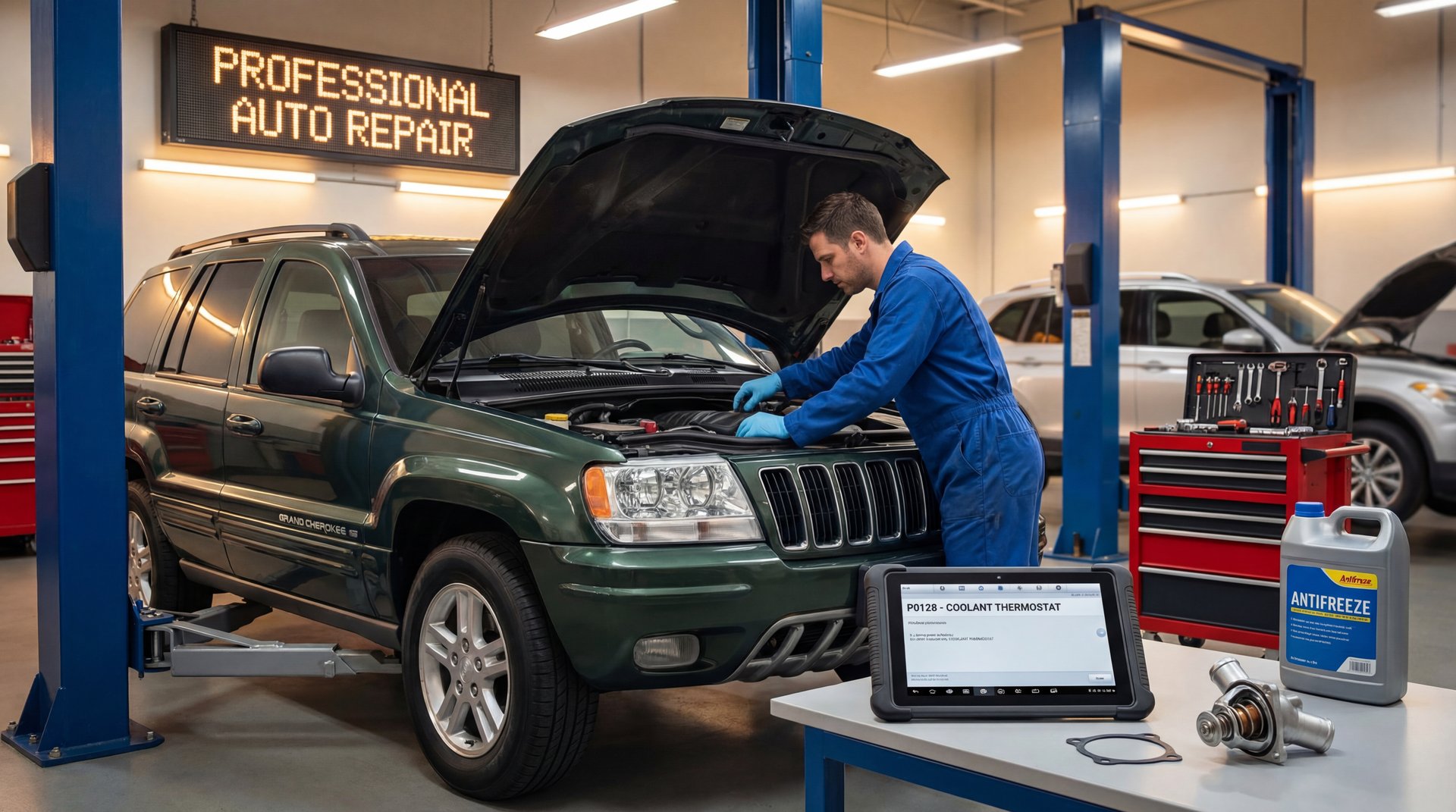
So you’ve got that annoying check engine light staring at you in your Jeep Grand Cherokee, and when you scanned it, you got a P0128 code – coolant temperature below regulated temperature. Don’t worry, I’m gonna walk you through exactly what this means and show you how to fix it yourself. What’s happening here is your engine coolant isn’t warming up fast enough or reaching the proper operating temperature like it should. And 99% of the time, we’re looking at a stuck-open thermostat that’s causing this issue.
The good news is this is totally something you can handle at home with basic tools, and you’ll save yourself anywhere from $370 to $700 versus taking it to a shop. Let me show you exactly what to check and how to get this fixed.
Checking Your Coolant Levels First
Alright, so before we jump into anything else, we need to make sure your coolant level is actually full. On the Jeep Grand Cherokee, we’re gonna check the overflow tank first. You’ll see it’s got markings on the side – usually a “full” line and an “add” mark down lower. In my case here, the overflow tank is actually a little overfull, which is fine.
But here’s the thing – checking just the overflow tank isn’t enough. We also need to verify the radiator itself is full, but you’ve gotta make absolutely sure the engine is cold when you do this. I can’t stress this enough – never open that radiator cap when the engine is hot. You’re dealing with coolant that can be up to 250°F under pressure, and removing that cap hot can cause it to explode and seriously burn you.
⚠️ Warning
Always let your engine cool for at least 2 hours before opening the radiator cap. Hot coolant under pressure can cause severe burns. Keep safety glasses and nitrile gloves on whenever you’re working with coolant.
Once you’ve confirmed both the radiator and overflow tank are full, and you’re still getting that P0128 code, we know it’s not a low coolant issue. That means we’re moving on to check the thermostat, which is what fails most of the time with this code. For this job, you’ll need about 10.5 to 12 quarts of coolant for a full flush – I always go with a 50/50 mix of OAT coolant and distilled water for these Jeep engines.
Locating the Thermostat on Your Jeep
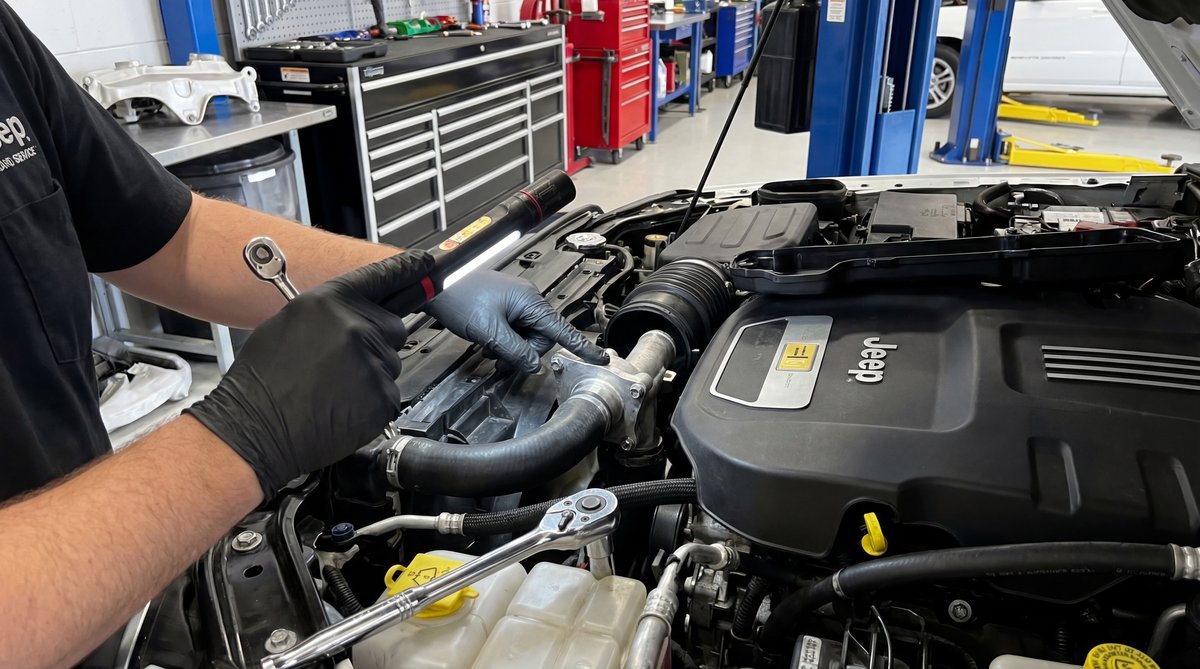
Alright guys, now we’re gonna remove this engine cover so I can show you exactly where the thermostat is located on this vehicle. On the Jeep Grand Cherokee with the 3.6L Pentastar V6 – which covers 2007 through 2021 models – finding the thermostat is pretty straightforward.
What we’re gonna do is follow the upper radiator hose. See this hose right here? Just trace it from the radiator, and it’s gonna lead you right to the thermostat housing. That’s your guy right there. The thermostat sits inside that housing assembly, and it’s usually about 12 to 18 inches from where the upper radiator hose connects.
🔧 Tools You’ll Need
- 8mm and 10mm sockets
- 6mm socket for hose clamps
- Drain pan (5+ gallon capacity)
- Torque wrench (inch-pounds)
- Pliers
- Funnel with hose
- OBD2 scan tool to clear the code
This setup is pretty common across a bunch of Chrysler products too – basically the same procedure works on Chrysler 300s, Dodge Chargers, and other models with the 3.2L or 3.6L Pentastar engines. If you’re dealing with other diagnostic codes on different vehicles, you might want to check out our guide on fixing P0008 codes on the Chevy Traverse – similar process of tracking down the problem systematically.
Understanding Why Thermostats Fail
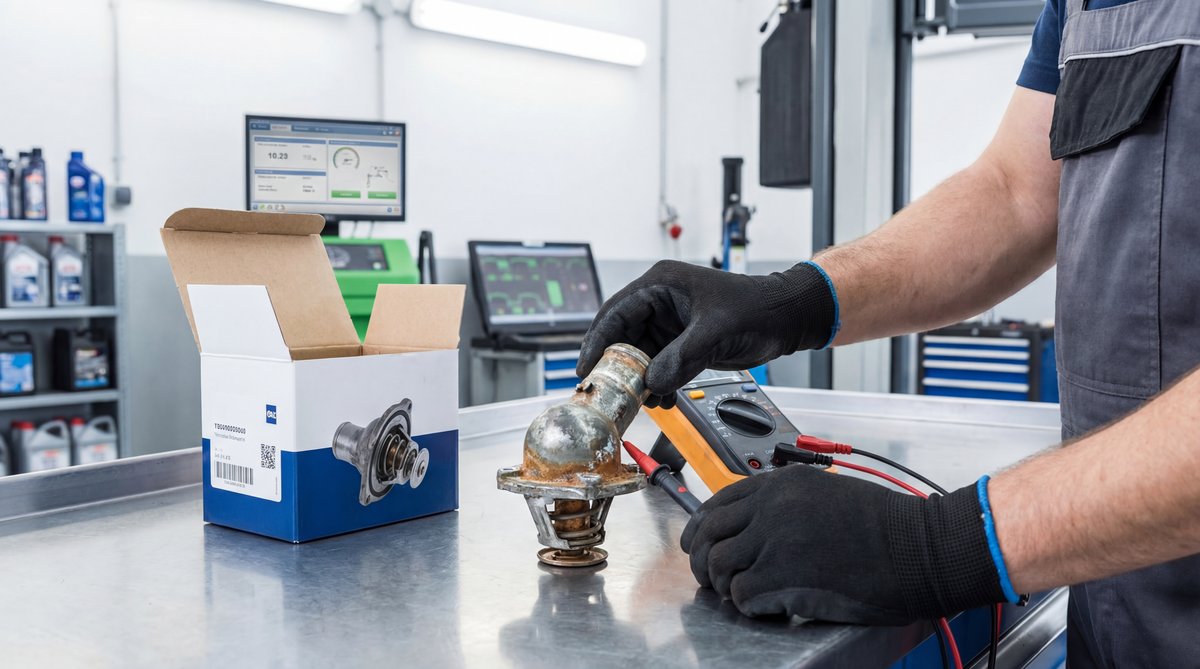
Let me show you what this Jeep Grand Cherokee thermostat actually looks like. So this is the complete thermostat assembly, and I want to explain what’s happening when you get that P0128 code.
Basically, the thermostat’s job is to stay closed when the engine is cold, which blocks coolant flow and lets the engine warm up quickly. Once the coolant hits about 195°F – that’s the opening temperature for most of these Jeep thermostats – it’s supposed to open up and let coolant flow through the radiator to keep things at the right temperature.
What happens 99% of the time with a P0128 code is this thermostat gets stuck open. When it’s stuck open, coolant is flowing through the system all the time, even when the engine is cold. That means your engine takes way longer to reach operating temperature, and in some cases, it might never fully get there. The computer is expecting the engine to hit that regulated temperature – usually around 195°F – within about 10 to 20 minutes of runtime, and when it doesn’t, boom, you get the P0128 code.
What happens 99% of the time is this gets stuck open. Which basically lets the coolant flow all the time, so it doesn’t get up to operating temperature as fast as it should.
You’ll usually notice some symptoms beyond just the check engine light. Your temperature gauge might stay lower than normal, you might get poor fuel economy – we’re talking a 15-20% drop in MPG – and your heater might not blow as hot as it used to. Some guys will keep driving like this for months, but you’re really hurting your fuel economy and risking sludge buildup in your engine from running too cool all the time.
❌ Common Mistake
Don’t reuse the old O-rings or gaskets when you install the new thermostat housing. Yeah, they might look okay, but they’ll leak within a few thousand miles. The new assembly should come with fresh O-rings – always use them.
Replacing the Thermostat and Housing
Alright, so replacing this thermostat and flushing out your coolant should fix that P0128 code. Let me walk you through the actual replacement process, because there’s a few things you need to know to do this right.
First, you’re gonna drain the coolant. There’s a petcock valve at the bottom of the radiator – get your drain pan underneath and open that up. You want to drain at least 80-100% of the coolant out of the system. While that’s draining, you can start working on removing the old thermostat housing.
The housing is held on with a few bolts – usually 8mm or 10mm. Real quick tip here: when you’re removing these bolts, keep track of which ones go where because sometimes they’re different lengths. Once the bolts are out, you can pull off the old housing. You might need to wiggle it a bit if the O-ring is stuck.
| DIY Cost | Shop Cost | You Save |
|---|---|---|
| $80-$200 | $450-$900 | $370-$700 |
Now, when it comes to parts, you’ve got a couple options. You can go with a budget-friendly option like the Dorman 902-689 thermostat housing assembly, which runs about $45 to $80. Or you can step up to the aluminum upgrade housing for about $120 to $150. The thing is, a lot of these come with plastic housings from the factory, and they can crack over time. The aluminum upgrade is worth it if you want to prevent having to do this job again in a few years.
🔧 Pro Tip
When you’re installing the new thermostat housing, don’t just tighten the bolts down randomly. Use a cross-pattern – basically tighten them like you would lug nuts on a wheel. This ensures even pressure and prevents warping. Torque them to 106 inch-pounds, and don’t go over that. These housings can crack if you over-torque them past 120 inch-pounds.
Before you install the new housing, make sure the mating surface on the engine is clean. Use a rag to wipe away any old gasket material or debris. Then put your new O-ring in place – it should be included with your new thermostat assembly. Line everything up, start the bolts by hand to make sure they thread in smoothly, then torque them down in that cross-pattern I mentioned.
Bleeding Air from the Cooling System
Alright, so you’ve got the new thermostat installed and everything’s bolted up. Now comes a really important step that a lot of people skip – bleeding the air out of the cooling system. If you don’t do this right, you’ll end up with air pockets that’ll cause all kinds of problems. Your heater might not work right, you could overheat, and guess what – that P0128 code might come right back.
Here’s what we’re gonna do. Fill the radiator with your 50/50 coolant mix – I use Zerex G-05 HOAT for these Jeeps, runs about $20 a gallon. Fill it slowly and watch the level. You should see a bleeder screw on the thermostat housing or nearby on the cooling system. Open that bleeder screw – just hand-tighten it, maybe 15-20 inch-pounds, no more than that.
Now start the engine and turn your heater on full blast, max temperature. Let the engine run at about 2000 RPM. What you’re looking for is coolant to start flowing out of that bleeder screw. At first, you’ll probably see some air bubbles mixed in with the coolant. Keep the engine running until you get a steady stream of coolant with no bubbles – this usually takes about 10 to 15 minutes.
💰 Money Saver
Don’t waste money on premixed coolant. Buy the concentrated stuff and mix it yourself with distilled water – you’ll pay about half the price. Just make sure you get the 50/50 ratio right. And here’s the thing – use distilled water, not tap water, because the minerals in tap water can cause corrosion in your cooling system down the line.
While you’re doing this, keep an eye on the coolant level in the radiator and keep topping it off as needed. The system will suck coolant in as the air bleeds out. Once you’ve got no more bubbles coming out of the bleeder, tighten it back up, top off the radiator one more time, and put the cap back on.
Let the engine come up to full operating temperature – your temperature gauge should read normal, right around the middle. Check for any leaks around the thermostat housing. If everything looks good, take it for a test drive. The P0128 code should clear itself after about 50 to 100 miles of driving, but you can also use your scan tool to clear it right away.
🔧 Pro Tip
After you drive it for a day or two, check your coolant level again. It’s normal for the level to drop slightly as any remaining air works its way out of the system. Just top it off if needed. If you’re constantly having to add coolant, you’ve got a leak somewhere that needs to be addressed.
One more thing – if the code comes back within the first 100 miles, you might have another issue going on. Could be a faulty ECT sensor, could be a water pump that’s not flowing properly, or in rare cases, it could even be a head gasket issue. But in most cases, replacing the thermostat and doing a proper coolant flush and bleed will take care of that P0128 code for good. Similar to how we approach other sensor-related codes, like in our article on P0705 transmission codes on the Nissan Versa, it’s all about systematic diagnosis and proper installation.
Frequently Asked Questions
What are the most common symptoms of a failing thermostat in a Jeep Grand Cherokee?
How do you properly drain and refill the coolant in a Jeep Grand Cherokee?
What tools are essential for replacing the thermostat in a Jeep Grand Cherokee?
Are there any specific brands of thermostats recommended for Jeep Grand Cherokees?
How can you tell if the thermostat is stuck open in your Jeep Grand Cherokee?