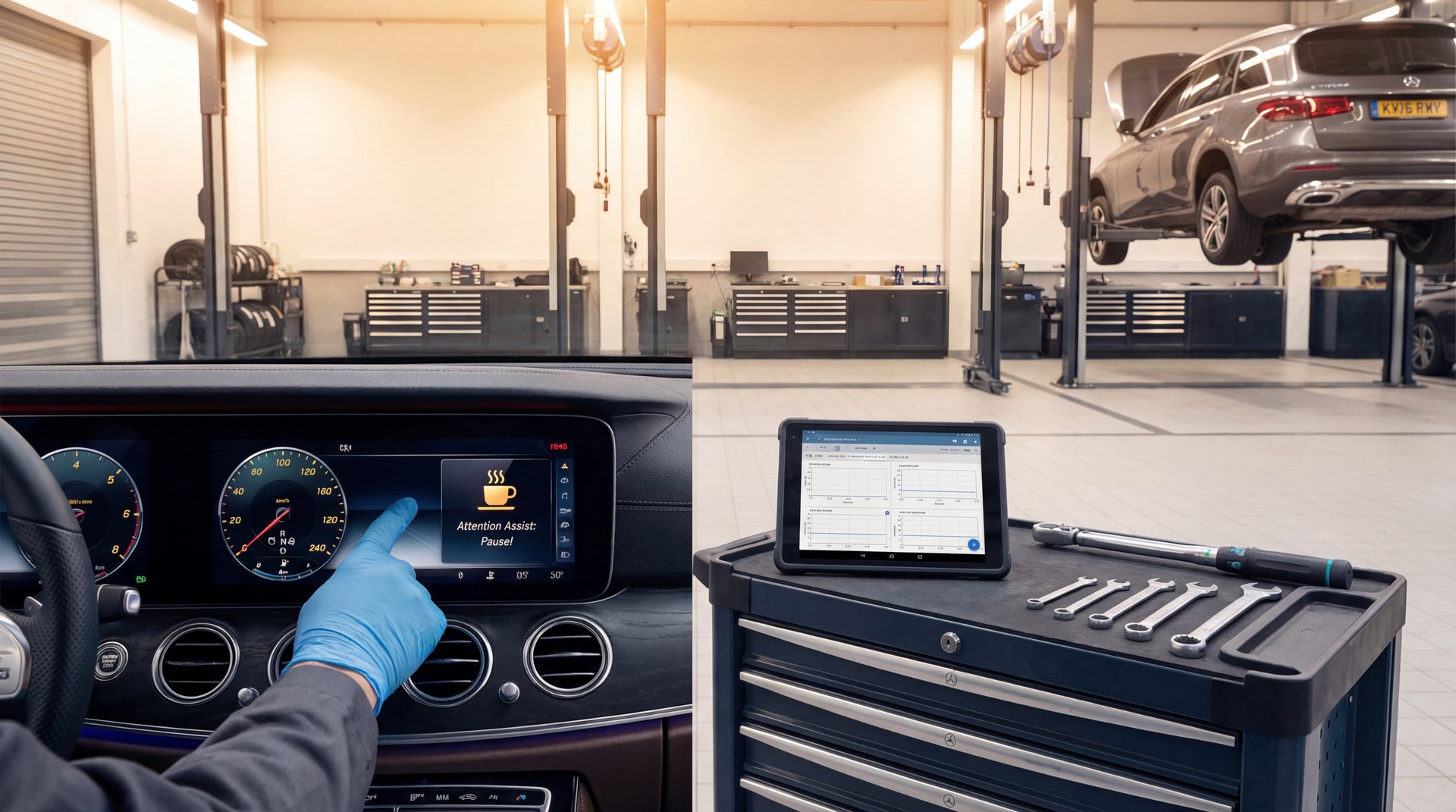
Alright guys, so you’re cruising down the highway in your Mercedes and all of a sudden a little coffee cup icon pops up on your instrument cluster. You’re probably thinking, “What the heck is that supposed to mean?” Well, that’s actually a really cool safety feature called Attention Assist, and what it’s doing is basically monitoring how you’re driving to see if you’re getting drowsy behind the wheel. Let me break down exactly what this system does and why you should actually pay attention when that coffee cup shows up.
What Is Attention Assist
The thing is, Mercedes really thought this one through. Attention Assist is basically your car’s way of being a co-pilot that’s looking out for signs that you’re getting tired. It’s been around since the mid-2000s on most Mercedes models, and what we’re gonna talk about is how it actually monitors your driving behavior to catch drowsiness before it becomes a serious problem.
This system will alert you if it notices drowsy driving patterns. Real quick, I want you to understand that this isn’t just some gimmick – according to recent industry reports on driver safety systems, these drowsiness detection features are becoming standard across commercial and passenger vehicles because they genuinely prevent accidents.
⚠️ Warning
Drowsy driving causes thousands of accidents every year. When that coffee cup icon appears, it’s not just a suggestion – it’s a serious safety alert that you should take action on immediately.
How the System Works
Alright guys, so here’s basically how this works. The system is constantly monitoring a bunch of different things while you’re driving. It’s looking at your steering inputs, how you’re correcting the wheel, your driving patterns, and in newer models with advanced versions, it’s even using infrared cameras to watch your eyes and head position.
What happens is the system learns your normal driving behavior during the first few minutes of your trip. It’s basically establishing a baseline. Then, if it starts noticing changes like erratic steering corrections, drifting between lanes, or in the advanced systems, increased blinking or yawning, it figures out that you might be getting drowsy.
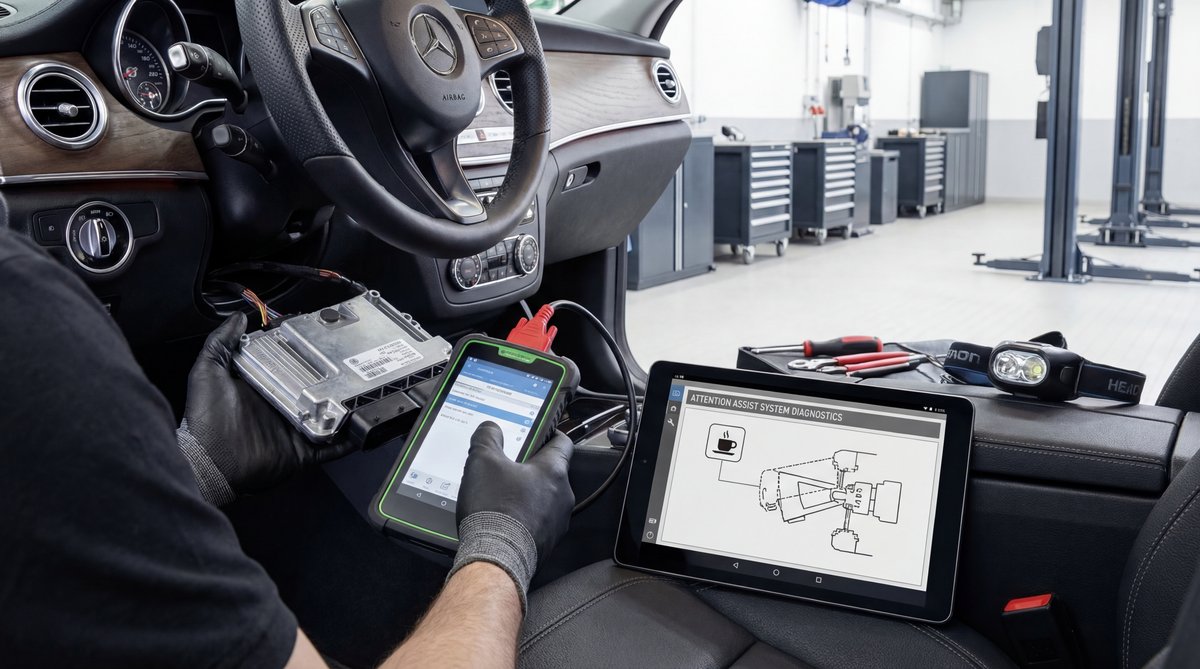
The sensors that make this happen are built into your steering column and, on newer models, there’s infrared cameras mounted near the instrument cluster. These aren’t the kind of parts you typically need to worry about replacing unless you’ve got a malfunction, but if you do, you’re looking at using a proper diagnostic scanner that’s compatible with Mercedes systems.
🔧 Pro Tip
The system works best on highway driving where you’re maintaining steady speeds. In stop-and-go city traffic, it might not be as accurate because your driving patterns are naturally more varied.
When the Coffee Cup Appears
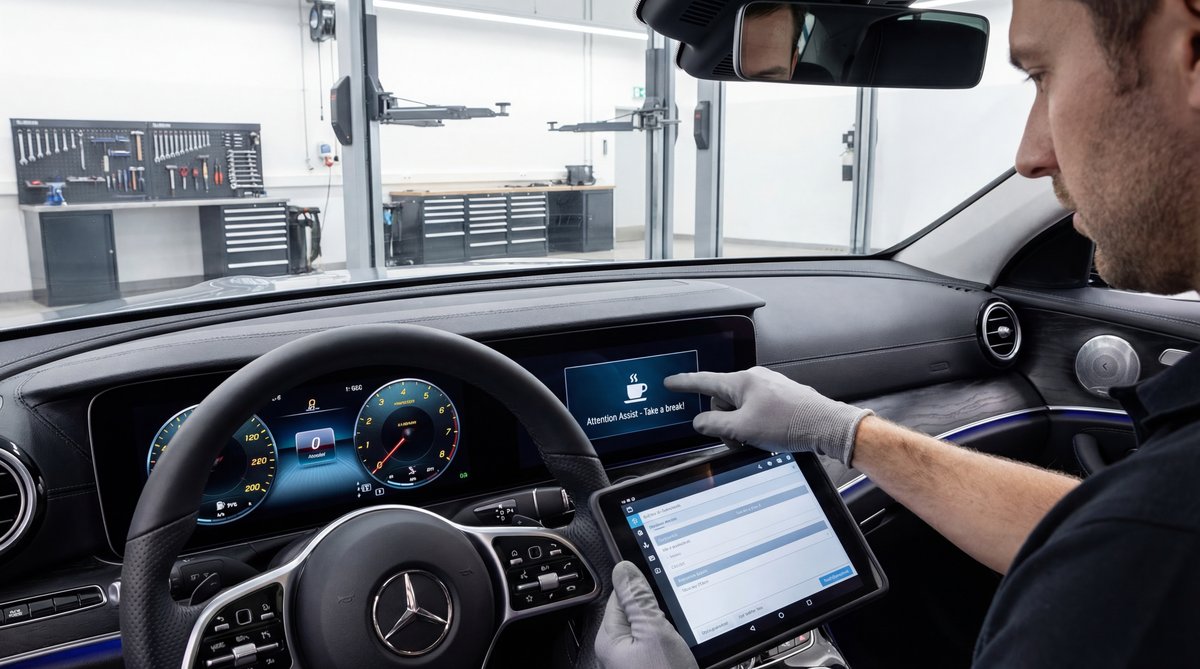
So when that coffee cup icon pops up on your dashboard, what it’s telling you is pretty straightforward – the system thinks you need a break. You’ll usually see the icon along with a message that says something like “Attention Assist: Take a Break” or similar wording depending on your model year.
Now, what you’re gonna do when this happens is actually take it seriously. I know it’s tempting to think “I’m fine, I can keep going,” but the thing is, the system is picking up on subtle changes in your driving that you might not even be aware of. That’s the whole point.
When that coffee cup shows up, safely pull over and take a break. Your car is literally telling you that it’s noticed you’re showing signs of fatigue.
Basically what you should do is find a safe place to pull over – a rest stop, gas station, whatever’s available – and take at least a 15-20 minute break. Get out, walk around, grab some actual coffee if you want. The system will reset once you’ve taken a break and started driving normally again.
❌ Common Mistake
A lot of people try to disable or ignore the Attention Assist warnings. Don’t do this. This system is there for your safety and the safety of everyone else on the road. Ignoring it defeats the entire purpose.
Troubleshooting False Alerts
Alright, so what if the coffee cup keeps showing up even when you’re not tired? This can happen, and there’s a few reasons why you might be getting false alerts.
First thing to check is whether something is interfering with the sensors. If you’ve recently had dashboard work done or replaced any components near the instrument cluster, the sensors might not be calibrated correctly. Also, if you’re driving on really curvy roads or in conditions where you’re naturally making a lot of steering corrections, the system might misinterpret that as drowsiness.
The thing is, if you’re consistently getting false alerts, you need to have the system diagnosed. What we’re gonna use for that is a Mercedes-compatible diagnostic scanner – something like Xentry or another professional-grade tool. These scanners can read the specific codes from the driver assistance module and tell you if there’s a sensor issue or if the system needs recalibration.
🔧 Tools for Diagnosing Issues
- Mercedes-compatible diagnostic scanner (Xentry or equivalent)
- Basic hand tools for dashboard access if needed
- Laptop with Mercedes diagnostic software
Now, if you need to replace a sensor or the driver assistance module, you’re looking at some real money. These modules typically run anywhere from $300 to $1,200 depending on your model and what year it is. And that’s just parts – if you’re taking it to the dealer, you’re gonna add another $200 to $450 in labor costs.
| DIY Cost | Shop Cost | You Save |
|---|---|---|
| $350-$1,350 | $550-$1,800 | $200-$800 |
💰 Money Saver
Before assuming you need a new module, check if your Mercedes is due for a software update. Sometimes the Attention Assist system just needs updated software from the dealer, which is way cheaper than replacing parts.
Attention Assist 2 Technology
Alright guys, so the newer Mercedes models – we’re talking like 2020 and newer, especially in their commercial trucks coming out in 2026 – are getting what’s called Attention Assist 2. This is basically the next generation of the system and it’s way more sophisticated.
What Attention Assist 2 does differently is it uses infrared cameras to actually watch your eyes and face. It’s monitoring things like how often you’re blinking, if you’re yawning, where your head is positioned, and even tracking your pupil movement. The thing is, this makes it way more accurate than the original system that mainly relied on steering inputs.
The main differences between the original Attention Assist and Attention Assist 2 come down to accuracy and monitoring methods. The first generation watches your steering behavior and driving patterns. Attention Assist 2 adds visual monitoring of your actual physical state. It can catch drowsiness earlier because it’s not just waiting for your driving to be affected – it’s seeing the signs of fatigue on your face before they impact your driving.
🔧 Pro Tip
If you’ve got Attention Assist 2 with the infrared camera, make sure you’re not wearing sunglasses that completely block your eyes. The system needs to see your eyes to work properly, though most good sunglasses still allow enough infrared light through.
Now, can these systems be integrated into other vehicle models? Basically, yeah, but it’s not a simple swap. The technology requires specific sensors, cameras, and most importantly, the software and control modules that can process all that data. You can’t just bolt this onto an older car without the whole driver assistance infrastructure.
As far as accuracy goes, the infrared cameras in detecting driver fatigue are pretty impressive. They’re the same type of technology used in some commercial trucking applications where safety and drowsiness prevention are critical. The systems can detect micro-sleep episodes and fatigue signs with a high degree of reliability, though they’re not perfect in all conditions.
Frequently Asked Questions
Can I turn off the Attention Assist system if I find it annoying?
Does Attention Assist work in all Mercedes models?
What’s the difference in how Attention Assist 2 prevents accidents compared to the original system?
How much does it cost to fix a malfunctioning Attention Assist system?
Are there common user experiences or complaints with the Attention Assist system?