
Alright guys, here’s something that 90% of people don’t know about their car, and honestly, it’s gonna save you from that awkward moment at the gas station. You know what I’m talking about – you’re driving someone else’s car, maybe a rental or a friend’s ride, and you pull up to the pump having absolutely no idea which side the gas filler tank is on. You end up doing this embarrassing shuffle, either repositioning the car or stretching that hose across, hoping nobody’s watching.
Well, the thing is, there’s a little secret hiding right there on your dashboard that tells you exactly where your gas cap is located. And once you know about it, you’ll never have that problem again.
The Fuel Gauge Arrow That Changed Everything
Here’s what we’re gonna do – next time you’re in your car, take a look at your fuel gauge. You’ll see this little arrow right next to the gas pump icon. That arrow tells you exactly which side your gas filler is on. If it points left, your gas cap is on the left side. Points right? You’re filling up on the right side.
This isn’t some random feature that only fancy cars have. According to automotive industry surveys, over 90% of vehicles made from 1989 onward have this arrow. We’re talking everything from basic economy cars to luxury rides, and yeah, even electric vehicles have their own version of it.
The crazy part? Most people drive their cars for years without ever noticing this thing. It’s one of those features that’s so simple and so obvious once you know about it, but somehow it just flies under the radar.
The Guy Who Invented This Brilliant Feature

Real quick, I gotta tell you the story behind this because it’s actually pretty cool. This whole arrow thing was invented by a guy named James Moylan who worked as an interior trim designer at Ford. And get this – he came up with the idea on April 17, 1986, after he got absolutely soaked filling up a company car in the rain because he pulled up to the wrong side of the pump.
Moylan was working on the 1989 Ford Escort and Mercury Tracer at the time, and he basically said “you know what, there’s gotta be a better way.” He submitted what Ford called a “product convenience suggestion” – basically an employee idea program – and they actually went with it. The arrow debuted on those 1989 models, and pretty soon every other manufacturer copied it because it was just too good not to use.
One simple arrow solved a problem that literally millions of drivers face every single day, and it cost manufacturers basically nothing to implement.
The thing is, Moylan didn’t get rich off this invention or anything. It was part of his job, so Ford owned the idea. But his contribution to car design went global – you’ll find this arrow in vehicles all over the world now. Sadly, Moylan passed away in December 2025, but his legacy lives on in pretty much every car you’ll ever drive.
🔧 Pro Tip
Some older Mercedes models from the 1970s and early 80s had a triangular low-fuel warning light that pointed toward the filler side, but Moylan’s arrow design became the industry standard because it was always visible, not just when you were running low on gas.
How to Use the Arrow (It’s Super Simple)
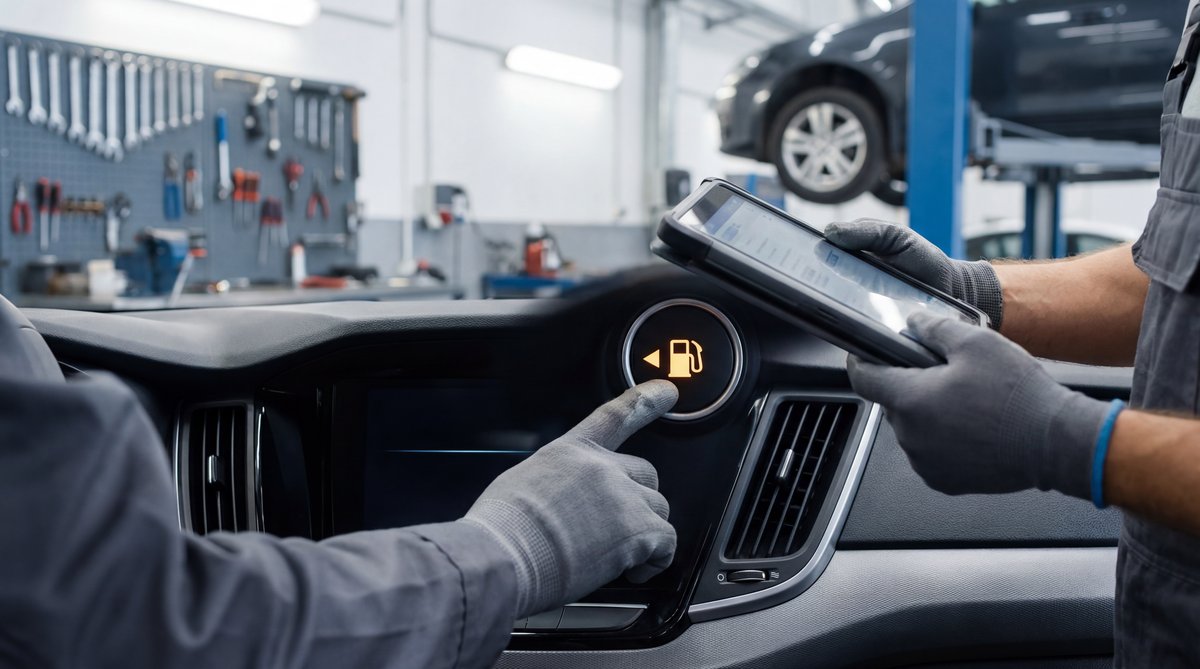
Alright, so here’s exactly what you need to do. Before you pull into a gas station – and I mean before, not after you’re already committed to a pump – glance down at your fuel gauge. Look for that little arrow next to the gas pump symbol. It’s usually pretty small, so you might need to actually look for it rather than just assuming it’s there.
Left arrow means your filler is on the driver’s side in most markets (though this can vary in right-hand drive countries). Right arrow means passenger side. It’s literally that simple.
❌ Common Mistake
Don’t assume all cars from the same manufacturer have the filler on the same side. A 2014 Ford Fiesta has it on the driver’s side, but a 2007 Ford Focus has it on the passenger side. Always check the arrow – there’s no industry-wide standard for which side manufacturers put the filler on.
This is especially useful when you’re dealing with rental cars. You know how it is – you’re in an unfamiliar vehicle, trying to get to your destination, and the last thing you want is to waste time at the gas station playing musical pumps. The arrow eliminates all that guesswork.
According to rental service reports, this simple feature saves drivers between 1-2 minutes per fill-up when they actually use it. That might not sound like much, but if you’re filling up 50 times a year, that’s anywhere from 2-4 hours of your life you’re getting back. Plus, you avoid looking like you don’t know what you’re doing.
What About Electric Vehicles and Hybrids
Here’s something interesting – electric vehicles and plug-in hybrids have adapted this same idea for their charging ports. Take the Nissan Leaf, for example. It’s got separate arrows showing you where both the slow-charge port and the DC fast-charge port are located, because yeah, some EVs have charging ports on different sides.
Plug-in hybrids like the Mercedes-AMG S63 take it even further – they’ve got dual arrows showing you where both the fuel filler AND the charging port are. Basically, if your vehicle needs some kind of external refueling or recharging, there’s probably an arrow telling you where to find it.
🔧 Pro Tip
On newer vehicles with head-up displays (about 70% of 2025 models and up), the fuel gauge information projects right onto your windshield, making that arrow even easier to spot before you pull into a station.
When the Arrow Is Missing or Wrong
Now, what if you look at your fuel gauge and there’s no arrow? Well, if you’re driving something made before 1989, you probably won’t have one. Pre-1989 vehicles weren’t required to have this feature, and most manufacturers hadn’t adopted it yet since Moylan literally just invented it.
If you’ve got a newer car and the arrow isn’t lighting up, you might have a bulb or fuse issue in your instrument cluster. The arrow is part of the gauge cluster graphics, and if that section isn’t illuminating, you could be looking at a failed bulb or electrical problem. This affects about 5% of vehicles that are 10+ years old.
⚠️ Warning
Don’t try to verify which side your filler is on by opening the gas cap while driving or when you’re near any kind of sparks or static electricity. Gas vapors are extremely flammable. Always check the arrow before you get to the station, or just do a quick walk-around of your vehicle if the arrow is missing.
If you need to replace your instrument cluster because the arrow isn’t showing up and it’s driving you crazy, you’re looking at somewhere between $500-1500 for a shop to diagnose and replace it. That’s 1-2 hours of labor at about $150/hour for 2025 rates, plus the cost of the cluster itself. For something like a Ford Escort cluster assembly, you’re looking at around $150-300 from aftermarket suppliers.
The thing is, you don’t really need to fix it just for the arrow. You can always check your owner’s manual or just remember which side your filler is on after the first fill-up. But if your whole gauge cluster is acting up – erratic fuel readings, dim lights, warning lights not working – then yeah, it’s worth getting it checked out.
| DIY Cost | Shop Cost | You Save |
|---|---|---|
| $0 | $100-200 | $100-200 |
Real quick on troubleshooting – if your arrow seems wrong (like it points left but your filler is actually on the right), double-check by looking at your manual or doing a physical inspection. It’s super rare for the arrow to be incorrect, but misreading can happen. In left-hand drive markets, “left” means the driver’s side, but on some models the terminology can get confusing.
💰 Money Saver
Before paying a shop $100-200 just to diagnose why your arrow isn’t showing, check your instrument cluster fuse first. It’s usually a 15-20 amp fuse, and you can test it yourself in about 5 minutes with a $10 fuse tester from any auto parts store.
Frequently Asked Questions
How did James Moylan’s invention impact car design globally?
Are there any other car features that were invented by ordinary people?
How did the introduction of the Moylan arrow affect car rental services?
What other innovations have come from Ford’s interior trim designers?
How do modern electric vehicles incorporate similar convenience features?