# I Drove My Car with the Wheel Falling Off (Here’s What Happened)
Alright guys, so I need to talk to you about something pretty crazy that happened to me recently – I actually drove my car with the wheel falling off. Now before you freak out, let me walk you through what happened, what causes this scary situation, and basically everything you need to know to avoid this nightmare scenario or fix it if it happens to you. The thing is, this is way more common than you’d think, and it’s super important to understand what’s going on before you end up stranded on the side of the road.
What Causes Wheels to Fail While Driving
So what we’re gonna do here is break down the main culprits that cause wheels to fall off while driving. Real quick, there are basically three main failure points you need to worry about.
First up, you’ve got your lug nuts. These are what actually hold the wheel onto the hub, and if they’re loose or missing, you’re in serious trouble. The thing is, under-torquing causes about 37% of wheel detachment failures. That’s huge. On something like a Ford F-150 from 2015-2023, you need those lug nuts torqued to 150 ft-lbs for the 14×2.0mm studs. On a Toyota Camry from 2018-2025, it’s only 76 ft-lbs for the M12x1.5 studs. See the difference? You can’t just guess at this stuff.
Second, you’ve got the wheel studs themselves. These are the threaded bolts that stick out of your hub that the lug nuts thread onto. If these are stripped, corroded, or sheared off, your lug nuts aren’t doing anything. You need at least 1.5mm of thread engagement per lug nut, or you’re basically driving on borrowed time.
Third is your hub assembly. If the hub is damaged, scored, or the bearings are shot, the whole wheel can wobble and eventually come off. Honda Civics from 2016-2025 use hub assembly OEM part number 44300-SR3-A01, and you need to torque that axle nut to 80 ft-lbs initial plus a 90-degree turn. Skip that 90-degree turn and you’re asking for problems.
⚠️ Warning
Never drive if your wheel wobbles, pulls to one side, or makes clunking noises. According to collision repair experts, immediate detachment at speeds over 40 mph can cause you to lose complete control of the vehicle. This isn’t something you mess around with.
Warning Signs Your Wheel Is About to Fall Off
Alright, so how do you know if your wheel is about to come off? There are some pretty obvious signs if you know what to look for.
First thing you’re gonna notice is vibration. If you’re cruising at 40-50 mph and you feel a serious vibration that wasn’t there before, something’s wrong. Could be your wheel, could be your hub, but either way you need to check it out.
Second is pulling. If your car is pulling hard to one side, especially when you’re braking, that’s a red flag. What’s happening is the frame is twisting from the imbalance, and this can cause alignment shifts greater than 2 degrees. That’s serious undercarriage damage territory.
Third – and this is the obvious one – clunking or banging noises. If you hear metal-on-metal sounds coming from your wheel area, especially over bumps or when turning, your lug nuts are probably loose or your studs are failing.
If you can visually see a gap between your wheel and the hub when you look at it from the side, pull over immediately. That gap means your lugs are basically gone.
Flat Rate Mechanic
You also want to watch for heat. If you stop and your wheel hub is crazy hot – like too hot to touch – your bearings might be failing. Check this after a drive by carefully touching the center of the wheel (not the brake rotor area, that’s always hot).
What to Do If Your Wheel Starts Coming Off
Okay, so let’s say you’re driving and you start feeling these symptoms. What do you do? Real quick, here’s the game plan.
First, do NOT keep driving. I know the title says I drove with the wheel falling off, but that was a mistake and I’m lucky nothing worse happened. Flying debris from wheel detachment injures about 39,000 people annually, and that’s not counting the damage to your own vehicle.
Pull over as safely as you can. Don’t slam on the brakes – that can make it worse. Just ease off the gas, put your hazards on, and get to the shoulder. If you’re on the highway, get to the nearest exit if you can do it safely.
Once you’re stopped, DO NOT try to drive it home. Call a tow truck. The thing is, even if you think you can limp it home, you’re risking serious damage to your suspension, alignment, brake lines, and even your frame. Plus you’re putting other people on the road at risk.
❌ Common Mistake
People think they can just tighten the lug nuts with whatever wrench they have in their trunk and keep driving. Wrong. If your lugs were loose enough to cause problems, you need to inspect the studs, check the hub for damage, and properly torque everything. You can’t fix this roadside.
If you absolutely have to move the car (like you’re in a dangerous spot), go slow – I’m talking 5-10 mph max – and only go far enough to get safe. Then call that tow truck.
Fixing a Wheel That’s Fallen Off or Coming Loose
Alright guys, so now we’re getting into how to actually fix this problem. What we’re gonna do is walk through the proper repair process.
First, you need to jack up the car safely. Use a floor jack (at least 2-ton capacity) and jack stands rated for at least 3 tons. Put wheel chocks behind the other wheels. This is serious business – don’t mess around with safety here.
🔧 Tools You’ll Need
Floor jack (2-ton minimum)
Jack stands (3-ton rated, set of 4)
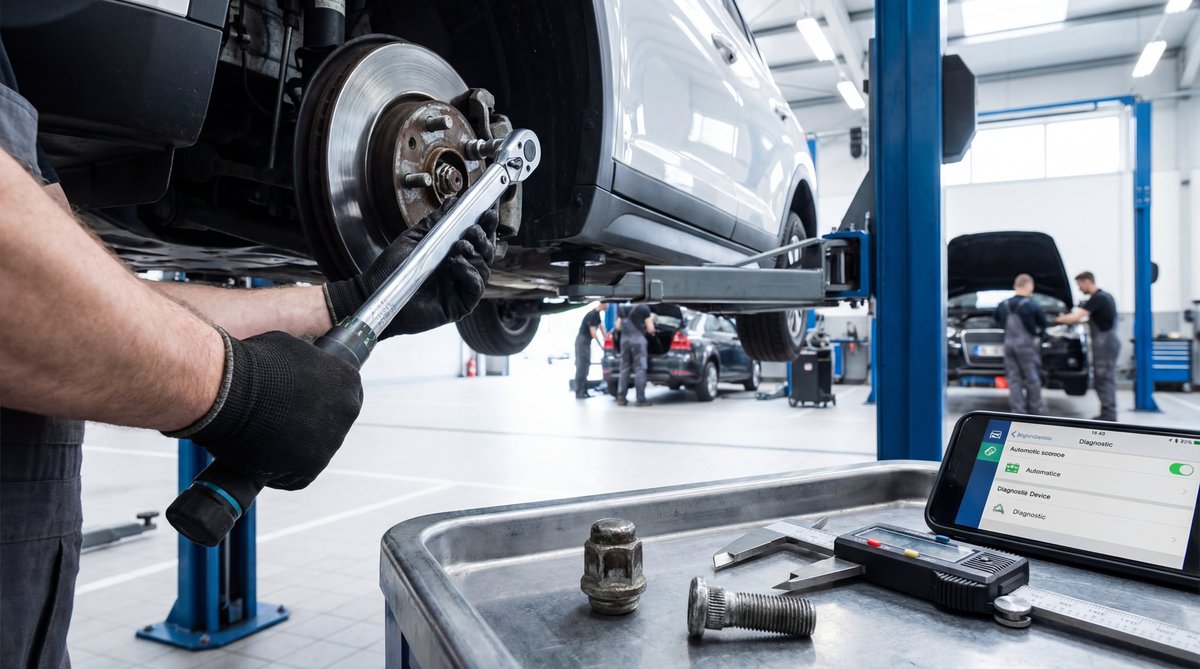
Torque wrench (100-250 ft-lbs range)
Socket set (19mm and 21mm most common)
Breaker bar
Wire brush
Thread chaser (M12x1.5 and M14x2.0)
Anti-seize compound
Impact wrench (optional but helpful)
Once the wheel is off, inspect everything. Look at your studs – are they stripped? Bent? If more than 20% of the threads are damaged, you need new studs. Check the hub face for scoring or damage. Look at the inside of the wheel where it mates to the hub – any damage there?
For the studs, clean them thoroughly with a wire brush. Any corrosion or old thread lock needs to come off. Run your thread chaser over them to make sure the threads are clean and smooth.
Now here’s where people mess up – you NEED to use anti-seize on the studs. Just a tiny bit, maybe 0.5 grams per stud. This prevents the nuts from galling and makes future removal way easier.
🔧 Pro Tip
When you’re installing the lug nuts, do it in a star pattern. Don’t just go around in a circle. You want to tighten them evenly to avoid warping the rotor or hub. Go around twice – first to snug them up, then with the torque wrench to spec.
Speaking of torque specs, you need to get this right. For a GM truck like a Silverado, you’re looking at 140-160 ft-lbs. For most mid-size sedans, it’s around 80-100 ft-lbs. Check your service manual for your specific vehicle. And whatever you do, don’t use an impact wrench without verifying torque with a torque wrench afterward. Impact wrenches can either under-torque or over-torque depending on your air pressure and socket condition.
After you torque everything, lower the car and drive it 50-100 miles, then recheck your torque. This is crucial – the lugs can settle in and loosen slightly during the first few drives.
DIY Cost
Shop Cost
You Save
$50-$200
$500-$1,600
$400-$1,400
The parts cost for this job is pretty reasonable if you’re doing it yourself. Budget lug nuts from Dorman run about $2-5 each, so for a full set of 20 you’re looking at $40-100. If you need studs, those are $10-15 each from brands like Timken. If your hub is damaged, that’s $100-300 for the part. Add in anti-seize and maybe some new tools you don’t have, and you’re still under $200 for most repairs.
Take it to a shop and you’re looking at 2-4 hours of labor at $150-300 per hour, plus they mark up parts by about 30%. Real quick, that’s $500-1,600 total. So yeah, doing it yourself saves serious money.
Preventing Wheel Failure in the Future
Okay, so you’ve fixed the problem. Now how do you make sure it doesn’t happen again? Basically, it comes down to regular maintenance and proper installation.
First thing – every time you get your tires rotated or any wheel work done, check your lug nut torque yourself afterward. Don’t just trust that the shop did it right. Takes you 10 minutes with a torque wrench, and proper torque procedures prevent the majority of wheel detachment incidents.
Second, inspect your lugs and studs every oil change. Look for corrosion, cracks, or damage. If you see rust building up, clean it off and apply fresh anti-seize.
💰 Money Saver
Buy a decent torque wrench and keep it in your garage. A good one costs $50-100 and will last you years. This one tool will prevent expensive wheel, hub, and suspension damage. Plus you can use it for tons of other jobs.
Third, if you have to remove a wheel (changing a flat, etc.), always retorque after 50-100 miles. This isn’t optional – it’s required. The lugs settle in as you drive and can loosen slightly.
Fourth, when you’re buying new wheels or having tires mounted, make sure the center bore matches your hub or you’re using proper hub-centric rings. If the wheel isn’t centered properly on the hub, you’ll get vibration and uneven stress on the lugs.
Also, avoid cheap chrome lug nuts. The chrome can swell and cause problems. Stick with OEM-spec nuts (look for Grade 10.9 marking) from decent brands like Gorilla Automotive or OEM parts. Yeah, they cost more – maybe $80-150 for a set instead of $20 – but they’re worth it.
Every 5,000
MILES
Check your lug nut torque to catch problems early
Real quick on related maintenance – if you’ve had a wheel come loose, you need to get an alignment check. The imbalance from driving with loose lugs can twist your frame by 1-3 degrees, which throws off your alignment. That’s an $80-120 service but it’ll save your tires and suspension in the long run.
Also consider replacing all your lugs and studs if one has failed. The thing is, if one failed, the others were under extra stress and might be weakened. Cascade failures are real – one lug fails, puts more stress on the others, and they start failing too.
Frequently Asked Questions
What are the most common causes of wheel failure while driving?
The most common causes are loose or under-torqued lug nuts (which cause about 37% of failures), worn or stripped wheel studs, and damaged hub assemblies. Basically, it comes down to improper installation or lack of maintenance. If someone uses an impact wrench without checking torque specs, or if the lugs weren’t retorqued after the first 50-100 miles, you’re at high risk. Corrosion on the studs can also cause lugs to loosen over time.
How can I safely drive if my wheel is falling off?
Real quick – you can’t. Don’t even try. If your wheel is showing signs of coming off (wobbling, pulling, clunking noises), pull over immediately and call a tow truck. Even at low speeds, a detaching wheel can cause loss of control, damage to your brake lines and suspension, and put other drivers at risk. If you’re in a truly dangerous spot, you can move the car at 5-10 mph maximum just far enough to get safe, then stop. But seriously, call for a tow – it’s way cheaper than the damage you’ll cause trying to drive it.
What tools do I need to repair a wheel that has fallen off?
You’ll need a floor jack (2-ton minimum), jack stands rated for at least 3 tons, a torque wrench that goes from 100-250 ft-lbs, socket set with 19mm and 21mm sockets (most common lug sizes), a breaker bar, wire brush, thread chaser for M12x1.5 and M14x2.0 threads, and anti-seize compound. If you’re replacing studs, you might need a hub puller and press. An impact wrench is helpful but not required – just make sure you verify torque with a torque wrench afterward if you use one.
Are there any specific brands of wheels that are more prone to falling off?
It’s not really about the wheel brand – it’s about the lug nuts and studs, and more importantly, proper installation. That said, cheap aftermarket wheels sometimes have quality control issues with the center bore or lug holes. Stick with reputable wheel brands and make sure you’re using the right lug nuts for your specific wheels. The thing is, any wheel will fall off if the lugs aren’t properly torqued or if the studs are damaged. Focus on proper installation and maintenance rather than worrying about specific brands.
How can I prevent my wheel from falling off in the future?
Check your lug nut torque every 5,000 miles with a torque wrench – this catches problems before they become dangerous. Always retorque lugs 50-100 miles after any wheel work. Use anti-seize on your studs (about 0.5g per stud) to prevent corrosion and galling. Inspect your lugs and studs at every oil change for damage or corrosion. Use quality, OEM-spec lug nuts (Grade 10.9 minimum) and avoid cheap chrome ones. And here’s a big one – after any wheel work at a shop, check the torque yourself. Don’t just trust they did it right.